Demolition Services in the
Texas Hill Country
Welcome to HBA Construction, your trusted partner for professional demolition services in Canyon Lake, Texas. If you're considering a demolition project, whether it's removing an old structure or preparing land for new construction, you've come to the right place. Let us show you why our expertise and commitment to quality make us the premier choice in the Hill Country of Texas.
Structure Removal, Concrete Demolition,
and Site Clearing Done Right
Demolition is almost always the first step toward something better — a new home where an old one stood, a clean building pad where a failing structure once sat, or usable land where a deteriorating outbuilding had been sitting for decades. Done right, demolition sets up everything that comes after it. Done wrong, it creates problems that compound through every phase of construction that follows.
HBA Construction provides residential demolition services across Canyon Lake, Bulverde, Spring Branch, New Braunfels, Wimberley, and the surrounding Texas Hill Country. We handle the teardown, the haul-off, and the site preparation — so the next crew that arrives finds a clean, ready property.
What Demolition Actually Involves
Most people picture demolition as the dramatic part — the moment a structure comes down. That part takes hours. The work surrounding it takes considerably longer and matters considerably more.
A professional demolition project involves:
Utility disconnection. Before any equipment touches a structure, all utilities must be properly disconnected. Gas lines, electrical service, water, and sewer connections each require coordination with the appropriate utility provider. Skipping or rushing this step creates serious safety risks. We handle the scheduling and coordination with utility companies before work begins.
Hazardous material assessment. Homes built before 1980 commonly contain asbestos in insulation, floor tiles, roofing materials, and pipe wrap. Lead paint is present in most pre-1978 construction. These materials require identification and proper handling before demolition begins. If your structure may contain hazardous materials, we will discuss the appropriate assessment and remediation steps before work starts.
Selective salvage. Not everything in a structure slated for demolition belongs in a dumpster. Reclaimed wood, vintage fixtures, usable lumber, metal, and architectural elements can often be removed before the main teardown and repurposed, donated, or sold. This reduces waste and occasionally recovers real value from the structure being removed.
The teardown itself. Equipment selection depends on the structure — its size, construction type, proximity to neighboring structures, and what needs to be protected nearby. A backhoe, excavator, or skid steer handles most residential demolition work efficiently. Structures close to utilities, fences, or neighboring homes require more precision and care than open-site teardowns.
Debris removal and haul-off. Once a structure comes down, you have a significant volume of mixed material — wood, concrete, metal, roofing, insulation — that needs to leave the property. We handle debris haul-off with our own dump trucks. This is not an afterthought; cleanup and haul-off are part of every demolition project we quote.
Site grading and preparation. After debris is removed, the foundation slab or pier footings typically remain. These can be broken up and removed or, in some cases, incorporated into the new construction depending on the plans. We grade the disturbed area and leave the site ready for the next phase of work.
Types of Demolition We Handle
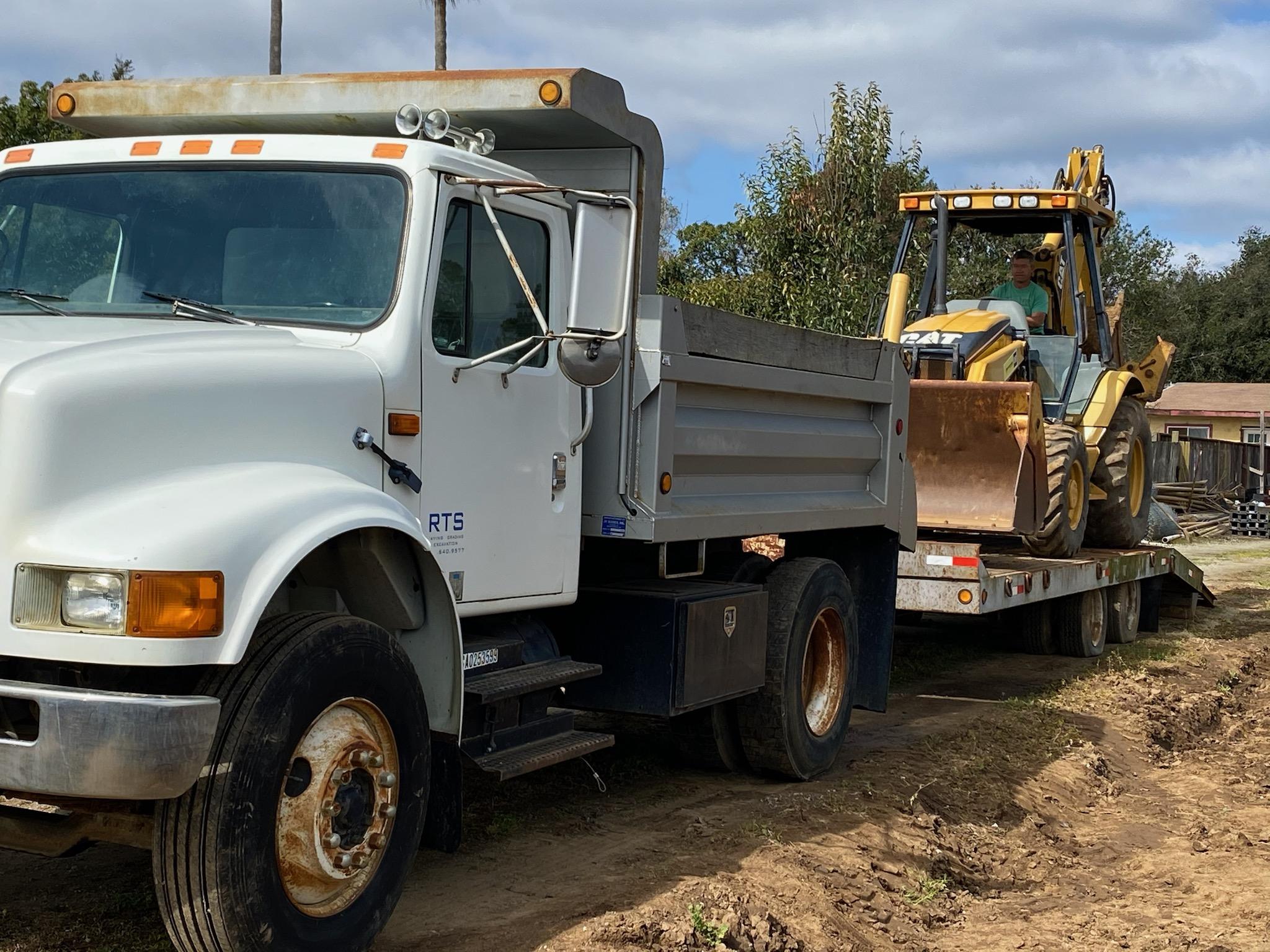
Full residential structure demolition. Complete teardown of a house, mobile home, or manufactured home. Includes disconnection coordination, teardown, foundation removal if needed, debris haul-off, and basic site grading.
Outbuilding and accessory structure removal. Barns, garages, sheds, carports, old fencing, and deteriorating outbuildings. These projects are often simpler than full house demolitions but still require the same approach to utility checks and debris management.
Concrete demolition and removal. Old driveways, slabs, sidewalks, and foundations. Concrete demolition in the Hill Country sometimes requires rock breaking equipment due to the depth of caliche and limestone beneath the surface. We have the equipment to handle it.
Selective interior demolition. Removing specific elements of a structure — walls, additions, attached structures — while leaving the main building intact. This requires more precision than full teardown and benefits from careful planning of the sequence of work.
Mobile home and manufactured home removal. A common project across Comal and Hays County. Mobile homes present specific challenges — utility disconnections, axle and frame removal, and pier or block foundation cleanup all require attention.
Demolition in Hill Country Terrain
Demolition in the Texas Hill Country comes with specific considerations that contractors from outside the area may not anticipate:
Shallow rock. Caliche and limestone close to the surface affects how foundation removal works and what equipment is needed. Breaking up a concrete slab that sits directly on limestone shelf requires different tooling than slab removal on soft soil.
Septic systems. Most rural Hill Country properties are on septic rather than municipal sewer. Before demolition, the septic system must be properly decommissioned or preserved depending on whether it will be reused. This is a regulatory requirement and a practical necessity.
Burn bans. Burning demolition debris on-site is common in some parts of Texas but frequently restricted in Comal and Hays counties during dry periods. We plan debris management around current burn ban status and have the trucks to haul off material when burning isn't an option.
Access. Many Hill Country properties have long driveways, low-clearance tree canopies, or steep approaches that affect what equipment can reach the site. We assess access during the initial site visit so there are no surprises on demo day.
Demolition FAQs
Q. Do I need a permit to demolish a structure in Comal County?
A. In most unincorporated areas of Comal County, a demolition permit is not required for residential structures. Properties within city limits — including New Braunfels — do require permits. We can help you determine what applies to your specific property and location.
Q. How long does residential demolition take?
A. A typical single-family home can be taken down in one day. Foundation removal, debris haul-off, and site grading add additional time depending on scope. A realistic full-project timeline — from first equipment on site to clean, graded ground — is two to four days for most residential projects.
Q. What happens to the debris?
A. We load and haul all demolition debris with our own dump trucks. Material goes to an appropriate disposal facility. If there are specific salvageable items you want removed before demolition — wood, fixtures, metal — let us know before work begins so we can account for that in the sequence.
Q. My house has asbestos. Can you still do the demolition?
A. We can, but asbestos-containing materials must be properly handled before conventional demolition equipment is used. This typically means bringing in a licensed abatement contractor to remove and dispose of the hazardous materials first, then we complete the teardown. We can help you understand the sequence and connect you with the right resources.
Q. Can you remove just part of a structure — an addition or attached garage?
A. Yes. Selective demolition is more involved than full teardown because the remaining structure needs to be protected throughout the process. It requires careful sequencing and attention to structural connections. We'll assess the specific situation during the site visit.
Q. How much does demolition cost in Texas?
A. Size of the structure, foundation type, presence of hazardous materials, debris volume, and site access all affect price. A straightforward mobile home removal is priced very differently than a full two-story house teardown with concrete foundation removal. The only way to give you an accurate number is to see the property. Call (830) 507-5956 for a free evaluation.
Q. What do I do about the septic system when I demolish a house?
A. If the septic system will not be reused, it needs to be properly decommissioned — typically by pumping the tank and collapsing or filling it according to county requirements. If a new structure will be built on the same property, the system may be preserved and reused depending on its condition and capacity. Your county environmental health office can advise on specific requirements.
What to Expect When You Work With HBA Construction
Every demolition project starts with a site visit. We look at the structure, assess access, check for utility connections, discuss what you're planning to build or do with the property afterward, and give you a straight price with no hidden costs.
We use our own equipment and our own crew — no subcontracted labor on demo day. When the work is done, we leave the site clean, graded, and ready for whatever comes next.
We serve Canyon Lake, Bulverde, Spring Branch, New Braunfels, Wimberley, Seguin, Boerne, San Marcos, and the surrounding Texas Hill Country.
Call (830) 507-5956 for your free property evaluation.
Call us for your FREE
Property or Project Evaluation
(830) 507-5956
- (830) 507-5956
- Demolition

Call today
(830) 507-5956
Email us:
dana@askhba.com
mailing address:
1015 twisted oak court
canyon lake, texas 78133